Skip to content
VecShield

VecShield

Privacy, compliance and security for your vector stores.

Know what your AI retrieves. VecShield inspects the content, permissions and retrieval behavior behind RAG applications—helping your team find sensitive data, review compliance evidence and investigate security risks.

An open-source Security & Compliance Console, with authorised red teaming for vector stores and RAG retrieval. Evidence for your team, not another opaque score.

Security & Compliance Console

From scattered risks to reviewable findings.

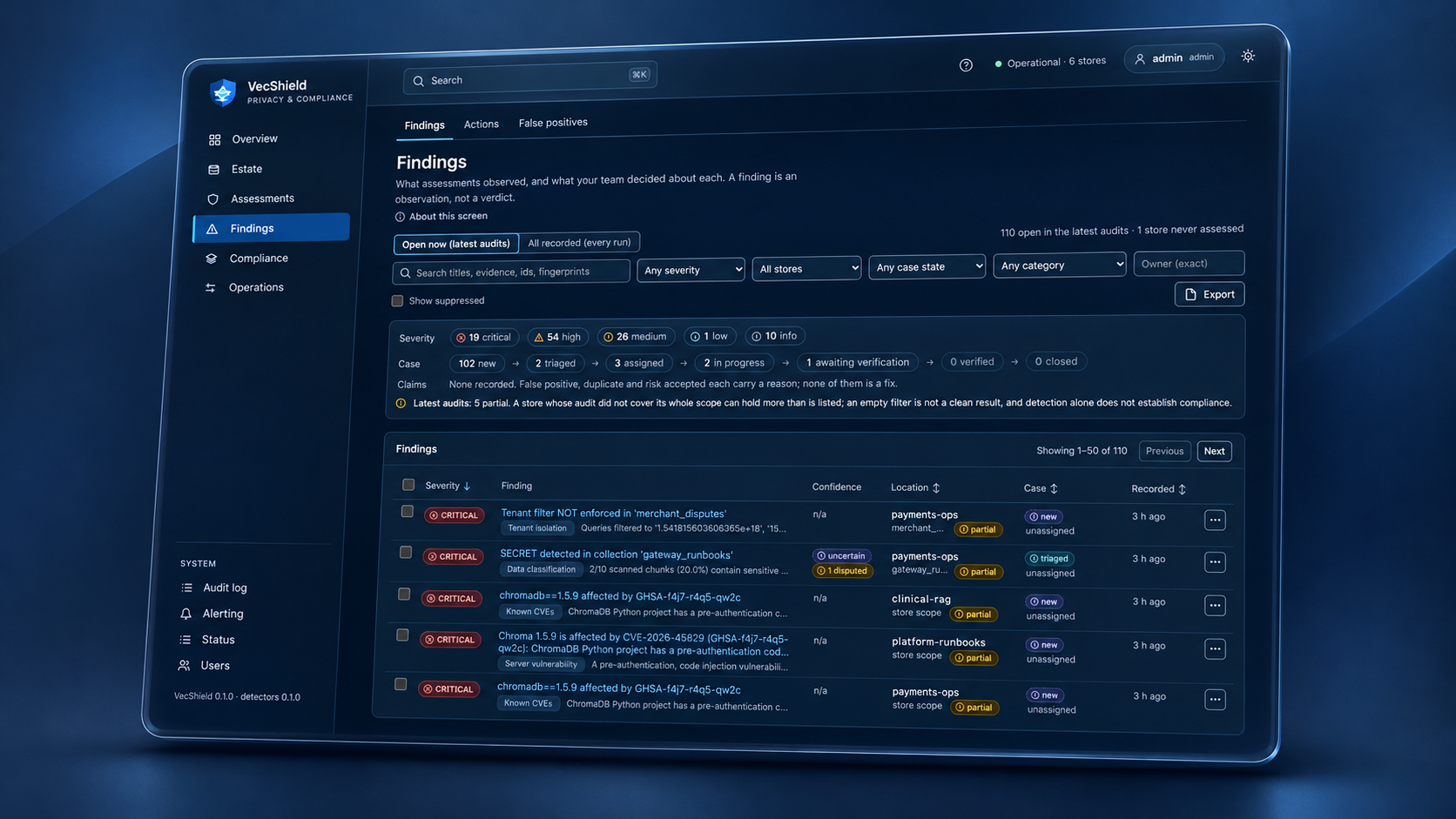
Review sensitive-data detections, tenant-isolation issues and vector-store vulnerabilities in one place. Each finding shows the evidence and coverage behind it, so your team can decide what needs attention and track the next action.

VecShield Findings console showing severity, assessment coverage and the review status of vector-store findings

Understand the data before it becomes an answer.

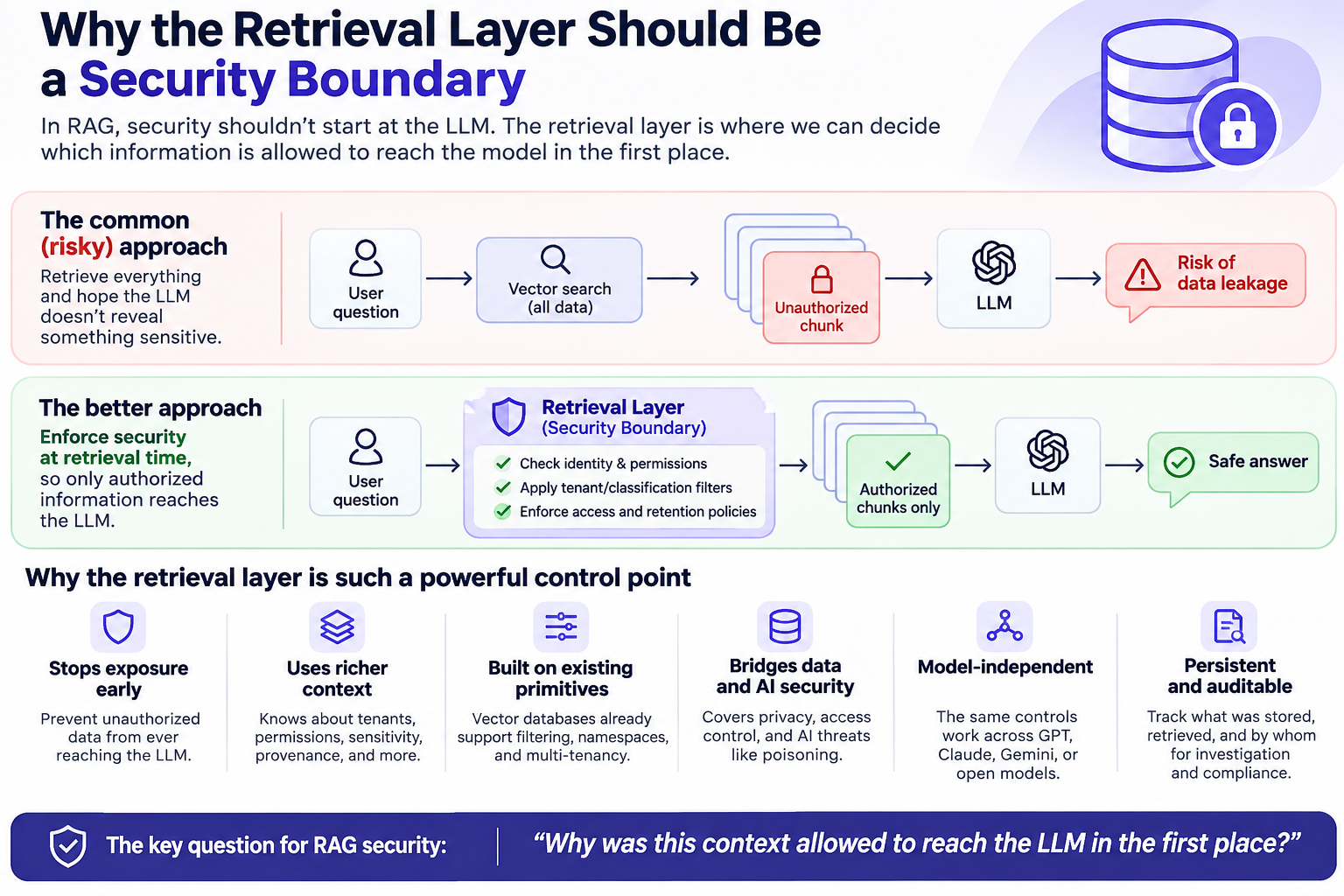
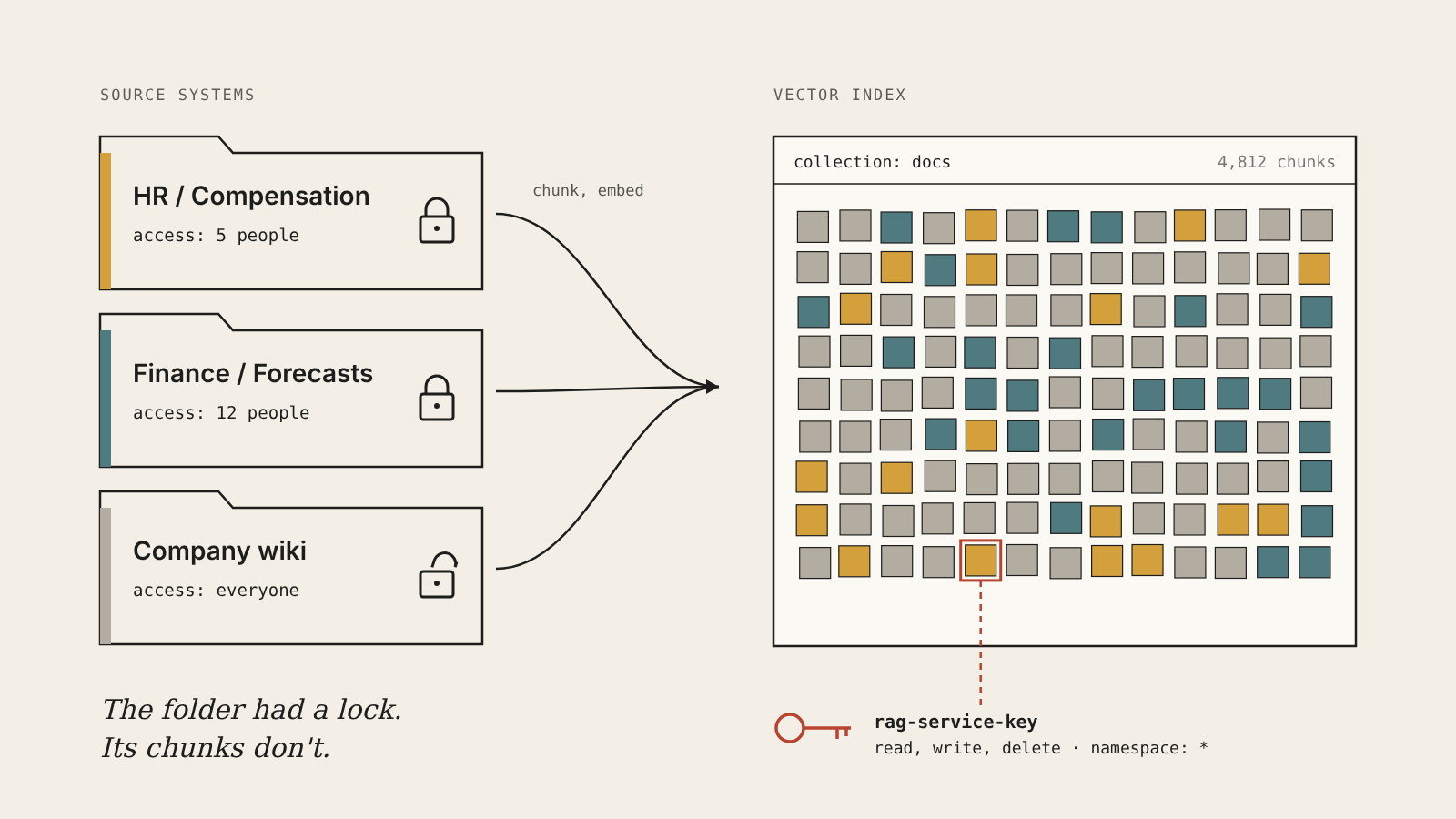
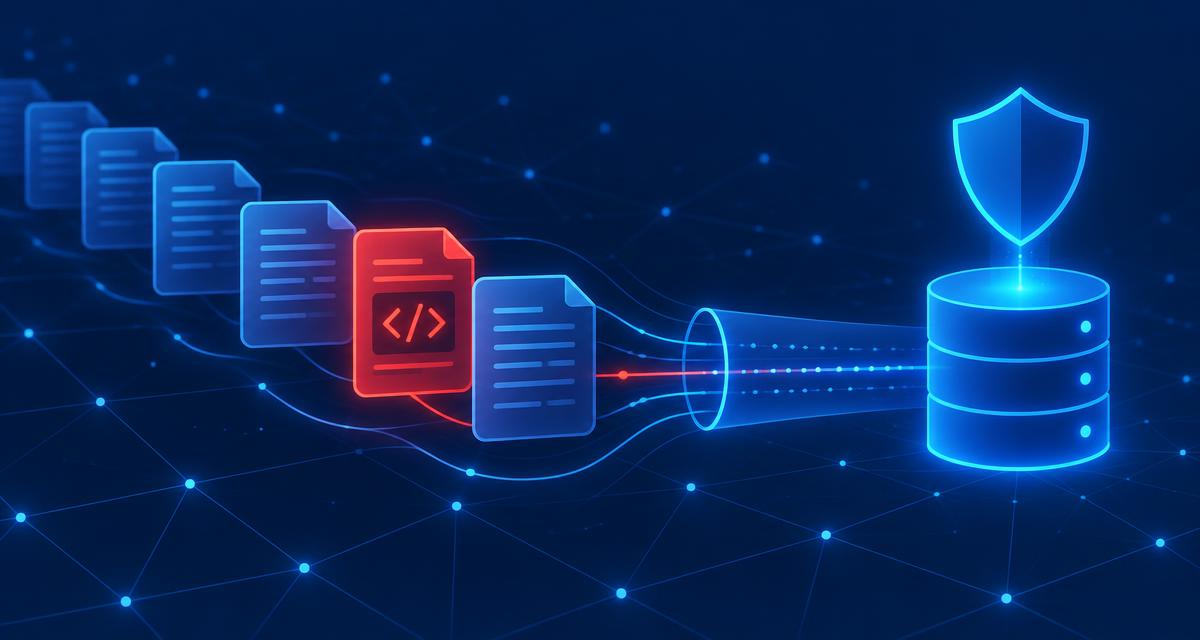
RAG gives a language model context from your documents. Those documents are split into chunks, indexed in a vector store and retrieved when someone asks a question. Sensitive information, poisoned content and missing access controls can travel along that same path. VecShield examines the store and retrieval layer where those risks begin.

  1. 01

    Sources

    Documents, tickets, wikis

    • Poisoned document
  2. 02

    Ingestion

    Chunk · embed · write

    • Missing provenance
  3. 03

    Vector store

    Chunks, metadata, embeddings

    • Sensitive data
    • Tenant leakage
    • Anomalous vectors
  4. 04

    Retrieval

    Similarity search, filters

    • Enumeration
    • Malicious context
  5. 05

    LLM

    Answer generation

    Highlighted: the parts of the pipeline VecShield examines.

    Run VecShield

    $ git clone https://github.com/Vecshield/vecshield
    $ cd vecshield/demo
    $ docker compose up --build

    The demo includes a synthetic estate and the full console at 127.0.0.1:8088. A generated admin password is printed on first boot.

    • Docker
    • Kubernetes / Helm
    • Terraform
    • Air-gapped

    VecShield runs alongside the vector infrastructure you already use. Scans and findings stay inside your environment.

    What VecShield examines

    RAG integrity

    Stored prompt-injection indicators, suspicious chunks, provenance gaps and anomalous embeddings.

    Data exposure

    Personal, health, payment and credential data stored in chunks and associated metadata.

    Tenant isolation

    Checks whether one tenant or namespace can retrieve data belonging to another.

    Vector-store posture

    Network exposure, TLS, encryption settings, known vulnerable dependencies and configuration issues.

    Access

    API keys, excessive permissions, stale credentials and access-control mismatches.

    Retrieval behavior

    Bulk reads, enumeration attempts and unusual collection-wide retrieval patterns.

    Content inspection

    Look closely at what goes into your knowledge base.

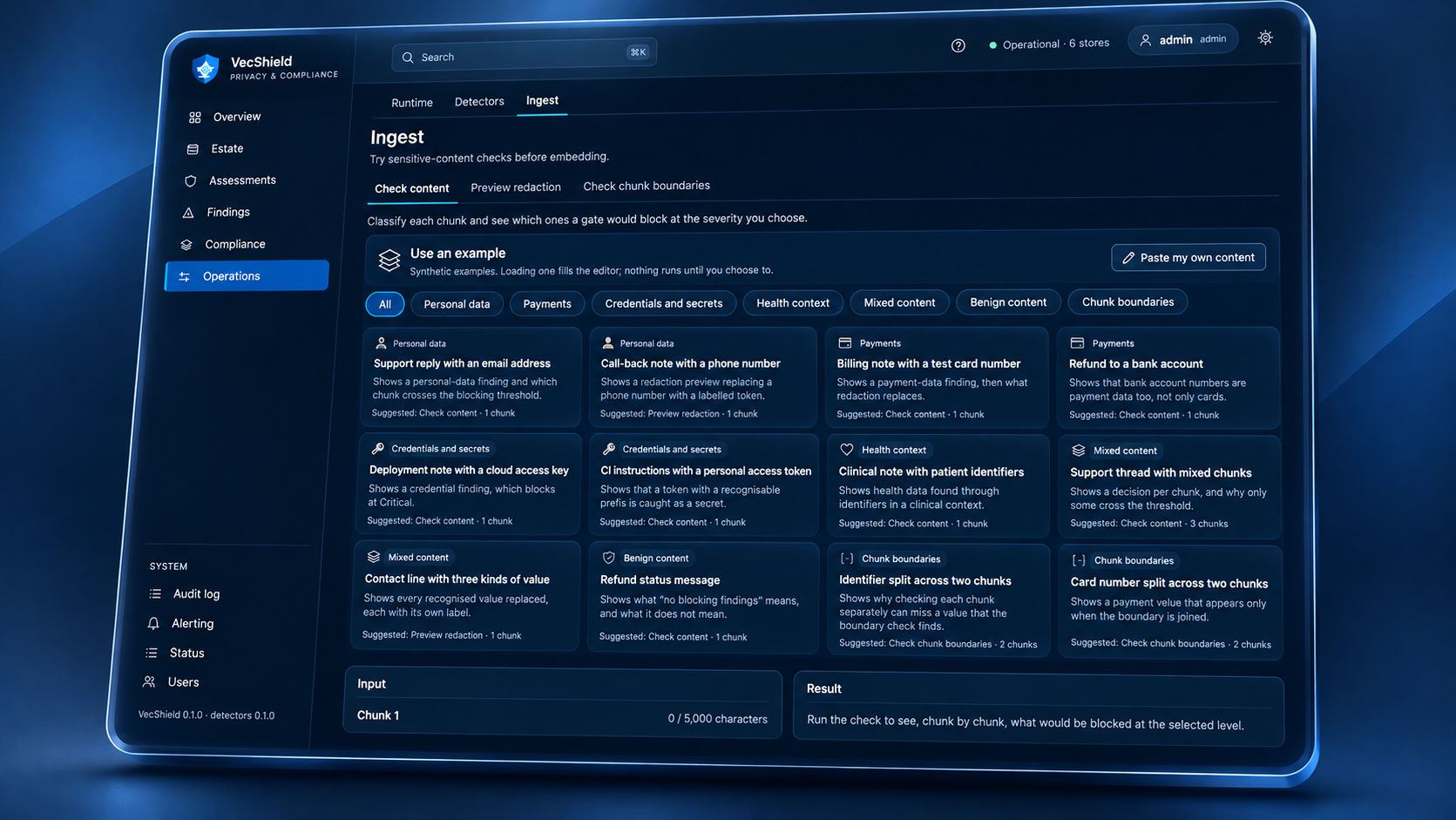
    Inspect chunks for personal data, health information, payment details and secrets. Review redaction previews and check whether splitting content across chunks hides a sensitive value—before deciding how that content should be handled.

    VecShield Ingest console with personal-data, payment, secret and chunk-boundary checks, plus redaction preview options

    Finding sensitive data is the starting point. VecShield maps observations to relevant frameworks, including GDPR, HIPAA and PCI-DSS, to support evidence review—not to declare compliance automatically.

    Explore compliance evidence →

    Test the risks around retrieval.

    Authorised red teaming tests whether poisoned knowledge can influence an answer, whether one tenant can retrieve another's data, and whether queries can extract a collection. These security checks complement sensitive-data discovery and compliance evidence review.

    Poisoning
    1. Attacker-controlled content

    2. RAG ingestion

    3. Poisoned knowledge base

    4. Malicious / incorrect retrieval

    5. LLM

    Data leakage
    1. Tenant A query

      One tenant's request

    2. Vector store

      Shared collection

    3. Tenant B chunk

      Cross-tenant data exposure

    Collection extraction
    1. Repeated semantic queries

    2. Progressive recovery

      Content collected across queries

    3. Stored knowledge

      Collection contents extracted

    VecShield focuses on the retrieval and vector-store layer. It is not a generic LLM jailbreak detector.

    Read the risk model →

    Works with the vector infrastructure you already use

    • Chroma
    • pgvector
    • Pinecone
    • Qdrant
    • Weaviate
    • Milvus
    • Redis
    • OpenSearch
    • MongoDB
    • OpenAI vector store
    • Azure AI Search
    • Amazon Bedrock Knowledge Bases
    • Vertex AI

    Architecture

    Connectors read from your vector stores. Optional monitoring records retrieval events. Detectors turn both into findings for data exposure, RAG integrity and access posture.

    VecShield runs in your environment and does not require sending vector-store contents to a VecShield-hosted service. Scans run against the store on their own schedule, not between your application and its queries.

    Read the architecture →
    VecShieldInside your environment

    Vector stores

    Connectors

    Read-only inspection

    Retrieval events

    Monitoring

    Optional event capture

    Detectors

    Data exposure · RAG integrity · access posture

    Findings & evidence

    Coverage, masked previews and audit records

    Security tools should say what they don't know.

    A result states what was scanned, what was sampled, what was skipped, what evidence supports a finding, what evidence argues against it, and what the detector cannot conclude. When a check samples a collection instead of reading all of it, the result is marked partial. There is no overall score.

    Coverage
    What the assessment actually examined.
    Counter-signal
    Evidence that weighs against a finding.
    Withheld
    A recommendation VecShield deliberately does not make because available evidence is insufficient.

    Detection is not a legal determination. VecShield produces evidence; humans make the final decision.

    Interested in the project?